












FMCSA has proposed no longer assigning MC Numbers. Consistent with statutory requirements, the USDOT Number would become the sole identifier for all FMCSA registrants. Individual registrations held by a distinct employer or person would be identified by unique suffixes within FMCSA’s systems, as required by MAP-21. This change is under consideration and will be available to comment on in a Notice of Proposed Rulemaking. It will not go into effect with the first release of the new registration system.
Last Updated:
The USDOT Number is a unique identifier that FMCSA uses to identify an employer or person’s operations. MAP-21 added a new requirement for safety registration for every employer or person operating commercial motor vehicles in interstate commerce. All distinct registrations or permits (e.g., operating authority registrations, safety registration, cargo tank facility registration, hazardous materials safety permits) held by one entity will eventually be associated with the USDOT Number. Safety registration is required for any employer or person operating commercial motor vehicles (CMVs) in interstate commerce. Safety registration is distinct from the USDOT Number. Before the Agency will issue safety registration, it must first determine that the applicant is willing and able to comply with all applicable statutory and regulatory requirements, is not affiliated with an unfit registrant or applicant, and has disclosed all relevant affiliations. In addition, MAP-21 requires every broker, freight forwarder, or motor carrier (whether operating commercial motor vehicles or not) to obtain a USDOT Number. FMCSA is modernizing its registration systems and process to eventually implement these MAP-21 requirements, however, safety registration will not be implemented with the first release of the new registration system.
Last Updated:
Existing registrants will keep their current USDOT Number. Previously registered brokers, freight forwarders, and motor carriers operating non-commercial vehicles who never received a USDOT Number in the past will receive a USDOT Number, as required by statute
Last Updated:
Motus is USDOT’s new registration system for FMCSA customers. The new system will provide tools to support all parts of the registration lifecycle, streamline processes, enhance fraud prevention, and provide a more intuitive, user-friendly experience for supporting companies, motor carriers, brokers, and other registrants.
Last Updated:
FMCSA is mandated by statute to build a unified registration system. FMCSA first established the system through rulemaking and with the completion of the Unified Registration System (URS) online application. FMCSA’s current modernization project will complete the system mandated in 49 USC 13908 and will allow FMCSA to incorporate key registration features required by MAP-21 over time. FMCSA is also developing the new registration system to improve the registration experience and processes for users. The new system will provide a user-friendly, streamlined approach to managing the registration life cycle of regulated entities. It will be designed to provide fraud-resistant security features, validate submissions in real time, and integrate data with all required State and Federal systems. It will also provide role-based access to easily navigate accurate registration data.
Last Updated:
Supporting companies—transportation service providers, blanket companies (BOC-3 filers), and financial responsibility filers (insurance/surety companies and other financial institutions)—now have limited access to Motus: USDOT Registration System to create user profiles and company accounts. All other customers, including new and existing registrants, will be able to access the system and take advantage of enhanced, user-friendly registration tools and information when Motus launches to all users in May 2026. After Motus launches, FMCSA will continue to release additional functionalities and collect feedback to identify new refinements and enhancements.
Last Updated:
Yes, FMCSA will use the new registration system to provide automated electronic notifications. FMCSA also intends to allow registrants to opt in to receive automated service of registration related notices and orders by electronic means. If a registrant does not opt in for service, they will receive routine communications electronically, but any order (or a notice that could result in a change to registration status) will continue to be mailed.
Last Updated:
Yes, the new registration system will be simple, secure, and seamless, and will be able to be accessed on mobile devices, tablets, and computers.
Last Updated:
Yes, the goal of the new system is to make changing information more intuitive and seamless. However, some changes require additional evidence or documentation, and FMCSA must review certain changes before allowing them to be reflected in the system.
Last Updated:
Motus is now available for submitting and managing filings. Users can enter new filings and manage existing ones directly within the Motus system. For any filing or motor carrier record activity after May 18, 2026, please use the Motus search function.
Last Updated:
No. If FMCSA stops issuing MC Numbers, existing MC Numbers will not be replaced by USDOT Numbers. The Moving Ahead for Progress in the 21st Century Act (P.L. 112-141) (MAP-21) requires all FMCSA regulated entities to have a USDOT Number. To comply with MAP-21, FMCSA began assigning USDOT Numbers to brokers, freight forwarders, and motor carriers who operate non-commercial motor vehicles and did not already hold a USDOT Number. Motor Carrier Docket Numbers (MC Numbers) were never a statutory or regulatory requirement. Historically, MC Numbers were used by FMCSA to track proceedings related to a single operating authority registration and not to identify a specific person, employer, operator, motor carrier, broker, or freight forwarder. The need for separate tracking numbers for each type of registration became unnecessary when all operating authorities became nationwide, with the elimination of route-specific and common or contract authorities, and with the newer requirement for all regulated entities to hold a USDOT Number. Rather than being replaced by USDOT Numbers, FMCSA is considering phasing out MC Numbers. Specific types of operating authority registration would instead be indicated by a suffix to the USDOT Number for each type an entity may hold.
Last Updated:
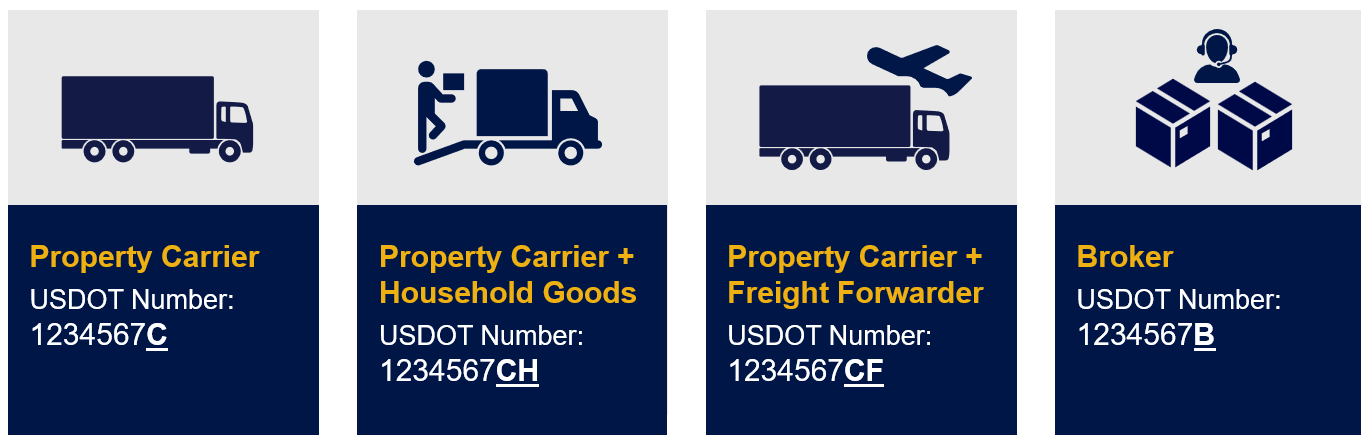
- Yes, a registrant may have multiple suffixes after their USDOT Number to identify specific registrations they hold. An entity with multiple operating authorities will have more than one suffix reflected in FMCSA systems. Suffixes would not be required for marking commercial motor vehicles but would be required by statute for identification on documents for business transactions involving freight forwarders, brokers, or motor carriers (for-hire non-exempt carriers). Here are some examples of how multiple suffixes may be displayed:
- Property Carrier: USDOT Number 1234567C
- Property Carrier + Household Goods: USDOT Number 1234567CH
- Property Carrier + Freight Forwarder: USDOT Number 1234567CF
- Broker: USDOT Number 1234567B
Last Updated:
On April, 29 2026, FMCSA published the official notice on the Federal Register announcing Motus, the new USDOT Registration System. The notice summarizes how Motus will satisfy regulatory requirements related to the Unified Registration System, the new system’s capabilities, and how the system will simplify existing registration processes.
Last Updated:
To change the Legal/DBA name associated with your company’s FMCSA Registration, you will need to submit the appropriate form(s) and supporting documentation to update your USDOT number record and (where applicable) your Operating Authority record(s). Please see the instructions below.
- Update your USDOT number Record (free of charge).
- Obtain the necessary form: To update your USDOT number record you will need to download the appropriate MCS-150 Series form: MCS-150 (Motor Carriers), MCS-150B (Motor Carrier with HazMat Permit), or MCS-150C (Intermodal Equipment Providers).
- Fill out the form: Please follow the instructions on the form to ensure all required information is completed accurately.
- Update the name on your Operating Authority record($14 fee required except for “pending” applications). If your company has a USDOT number only, skip to step 3.
- Obtain the necessary form: To complete a name change request, you will need to submit the MCSA-5889 - Motor Carrier Records Change Form.
- Fill out the form: Fill out the MCSA-5889 form with accurate and up-to-date information. To complete the MCSA-5589 form for a name change request, complete the following sections:
- Section A – Complete Section A with the current Legal Business and/or DBA name on file with FMCSA.
- Section C – Complete Section C with the updated Legal Business and/or DBA name.
- Section E – Provide your payment information so FMCSA may process the $14 fee associated with a name change request. Please note, if your operating authority application is “Pending,” there is no fee required, and Section E can be left blank.
- Gather supporting documents: Along with the MCS-150 and/or MCSA-5889 form, you will need to provide supporting documents that verify the name change.
- Sole Proprietors/Partnerships: Documents may include a marriage/death certificate, divorce decree, court order, or other legal documentation.
- Corporations: Documents may include Certificates of Amendment (typically includes the old and new company names); Amended Articles of Incorporation; Articles of Incorporation in cases where the Secretary of State does not provide Articles of Amendment.
- All Requestors: The Company Officer signing the Certification Statement on the MCS-150 form and (where applicable) the Applicant’s Oath in Section A of Form MCSA-5889 must also submit a copy of his/her current government-issued ID (such as a U.S. passport, driver’s license, or resident card).
- Submit the request: Once you have completed the appropriate form(s) and gathered all the required supporting documents, submit the request and documentation to FMCSA via a ticket to the FMCSA Contact Center (complete the required fields and upload your documents).
- After the documents are submitted: Once you have submitted the name change request along with all the required documentation, the form will be reviewed for processing.
- Requests are processed in the order that they are received. For additional information about processing times for registration forms, please see our FMCSA Registration Forms page.
- Once FMCSA notifies you that your request has been processed, please allow 24-48 hours for the new name to be visible on FMCSA SAFER Company Snapshot website and (if the company has Operating Authority) the FMCSA Licensing and Insurance Public website. You can verify the updated information there.
- Additionally, for name changes to an Operating Authority record, a hard copy of the Re-entitlement letter will be mailed to you via the United States Postal Service (USPS). You can also print the letter via the Daily FMCSA Registration Decisions.
In some cases, a legal name change, ownership change, or change in form of business may require a new USDOT number. For more information on this, click here. FMCSA may contact you for additional information regarding your name change request.
After FMCSA issues your Re-entitlement letter for name changes to Operating Authority: The amended BOC-3 form, and proof of insurance filings need to be filed with FMCSA within thirty (30) days of the name change. Your operating authority registration will be at risk of being revoked if the amended BOC-3 form and insurance requirement are not updated in a timely manner. For more information on insurance requirements, visit our Insurance Requirements webpage.
Last Updated:
An authorized for-hire motor carrier transports passengers, regulated property or household goods owned by others for compensation. If you are a for-hire carrier, in addition to the USDOT number you will also need to obtain operating authority (MC number).
You can review the different types of authority by clicking here.
For information on how to apply for for-hire authority, click here.
Last Updated:
Yes. All entities with a USDOT number are required to file a biennial update every two years according to the prescribed schedule, by the last day of the month.
You can file a biennial update prior to the time that an update is due. FMCSA considers any update of an MCS-150 or MCS-150C that was completed by a motor carrier, Intermodal Equipment Provider (IEP), or carrier that has been issued a Hazardous Materials Safety Permit (HMSP) at any time during the 12 months immediately preceding the biennial update due date to satisfy the biennial update requirement.
For information on how to file your biennial update, click here.
Last Updated:
Who is eligible to obtain temporary authority?
A motor or passenger carrier wishing to apply for temporary operating authority registration authorizing for-hire commercial motor and passenger vehicle operations, while providing direct assistance supporting emergency relief efforts transporting supplies, equipment and persons into or from the zone where the emergency is taking place.
When is temporary authority available?
Applications for temporary authority require a determination that there is, or soon will be, an immediate transportation need that cannot be met by existing motor carrier service. 49 CFR 365.107T(f). Such applications are only entertained in exceptional circumstances, during natural disasters or national emergencies. 49 CFR 365.107T(g). In most circumstances, the Agency will only entertain applications for temporary authority when an emergency declaration has been issued, consistent with 49 CFR 390.23.
Where can I find information on current emergency declarations?
Go to https://www.fmcsa.dot.gov/emergency for links to current FMCSA emergency declarations. The temporary authority is only active as long as the emergency declaration is in effect. All temporary authorities will be revoked once the emergency declaration expires.
How can a carrier apply for this temporary authority?
- If a carrier does not have a USDOT number, they must apply for one by submitting a signed MCS-150 form (write “Emergency Temporary Authority” at the top) with their OP-1, rather than filing via URS. To access the MCS-150 form, click here. Carriers that are subject to an FMCSA Out of Service Order are not eligible for temporary authority.
- A carrier must file a signed form OP-1 with “Emergency Temporary Authority” written at the top along with the specific Emergency Declaration found at https://www.fmcsa.dot.gov/emergency-declarations by web form rather than online. To access form OP-1, click here. You can submit a ticket through our website at: ask.fmcsa.dot.gov. Select Inquiry Type: Operating Authority (Docket Number) > Request temporary operating authority due to an emergency declaration – This is the fastest option
- The application fee has been waived.
- The carrier must also file proof of insurance and have form BOC-3 (Designation of Process Agent) on file with FMCSA. For more information on insurance requirements click here, and for and BOC-3 requirements, click here.
- Pursuant to 49 CFR 365.107T(g), the carrier is also required to provide a statement on why they need temporary operating authority, appended to Form OP-1 for property carriers, Form OP-1(MX) for Mexican property carriers and, Form OP-1(P) for motor passenger carriers.
How long does it take for temporary authority to be granted?
OP-1 applications for temporary authority should be processed within 48 business hours of receipt. However, the authority will not be granted until the carrier’s evidence of financial responsibility (insurance) and BOC-3 form are on file with FMCSA.
The authority is valid for 120 days or until the emergency declaration expires, whichever comes first.
If a carrier wishes to apply for permanent authority, they need to apply using the same MC/USDOT number granted for the temporary authority. The applicant would be required to pay the $300 fee for permanent operating authority registration, as well. For more information, click here.
Last Updated:
Yes, you will keep the same MC number if you change your name. However, you will not receive a new certificate or permit, but you will receive a re-entitlement decision which should be attached to your original operating authority.
For information on how to change the name on your operating authority, click here.
There are situations where a legal name change, ownership change or form of business change may require a new USDOT number. For more information, click here.
Last Updated:
- First-time applicants registering via the Unified Registration System or existing carriers applying for property carrier applications using the OP-1 form may take 20-25 business days
- Email or Fax: OP-1 Property carrier applications (existing carriers only) may take 3-7 business days
- Mail: OP-1 Property carrier applications (existing carriers only) may take 45-60 business days
- Authority applications that are identified for vetting may take an additional 2-8 weeks. For more information on the vetting process, click here.
USDOT number:
- Online via the Unified Registration System: USDOT numbers are given instantly; a carrier notification letter will follow in the mail
Last Updated:
A Commercial Motor Vehicle (CMV) is defined as any motor vehicle used on a highway in interstate commerce to transport property or passengers when the vehicle:
-
- Has a gross vehicle weight rating (GVWR) of 10,001 pounds or more
- Is single or combination of vehicles with a gross vehicle weight rating (GVWR) of 26,001 pounds or more
- Is designed or used to transport more than 8 passengers (including the driver) for compensation; or more than 15 passengers if not receiving compensation for the transportation.
- Any size vehicle that transports hazardous materials that require federal placarding
On the other hand, a non-Commercial Motor Vehicle would not meet the above criteria. For example, consider a vehicle where either the power unit alone or when combined with a trailer does not meet the minimum weight threshold of 10,001 pounds. For instance, a pickup truck with a GVWR of 7,000 pounds and a trailer with a GVWR of 2,000 pounds would not qualify as a CMV.
Visit the vehicle configuration page to learn more about the different types of CMVs
Last Updated: