


Frequently Asked Questions
No. A motor carrier cannot broker loads without first applying for and receiving a license to operate as a property broker.
In certain situations, a moving company can legally put your household goods in storage at your expense.
At the agreed upon time of delivery, you must pay for the charges due and be available to accept delivery of your shipment or it could be placed in storage at your expense.
To learn more, read the FMCSA’s Your Rights and Responsibilities When You Move booklet
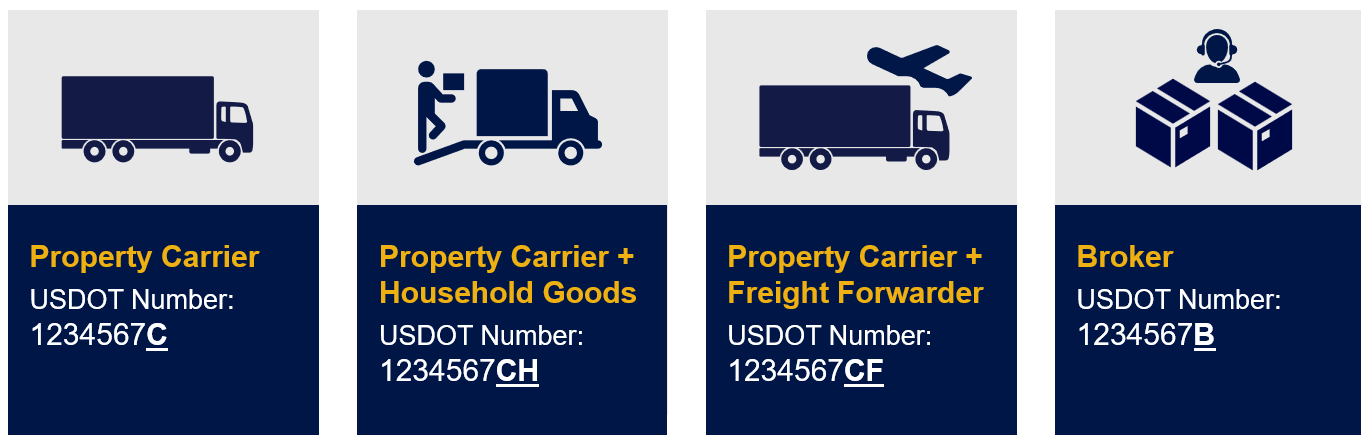
- Yes, a registrant may have multiple suffixes after their USDOT Number to identify specific registrations they hold. An entity with multiple operating authorities will have more than one suffix reflected in FMCSA systems. Suffixes would not be required for marking commercial motor vehicles but would be required by statute for identification on documents for business transactions involving freight forwarders, brokers, or motor carriers (for-hire non-exempt carriers). Here are some examples of how multiple suffixes may be displayed:
- Property Carrier: USDOT Number 1234567C
- Property Carrier + Household Goods: USDOT Number 1234567CH
- Property Carrier + Freight Forwarder: USDOT Number 1234567CF
- Broker: USDOT Number 1234567B
49 CFR Section 390.3(d) gives employers the right to adopt stricter medical standards. Motor Carriers (companies) cannot set less restrictive standards. In addition, the employer can require the driver to perform ancillary duties as a condition of employment.
Last Updated : April 1, 2014
Provigil (Modafinil) is a medication used to treat excessive sleepiness caused by certain sleep disorders. These sleep disorders are narcolepsy, obstructive sleep apnea/hypopnea syndrome and shift work sleep disorders. Provigil has severalconcerning side effects such as chest pain, dizziness, difficulty breathing, heart palpitations, irregular and/or fast heartbeat, increased blood pressure, tremors or shaking movements, anxiety, nervousness, rapidly changing mood, problems with memory, blurred vision or other vision changes to name a few. Many drugs interact with Provigil which include over-the-counter medications, prescription medications, nutritional supplements, herbal products, alcohol containing beverages and caffeine. The use of Provigil needs careful supervision. Provigil may affect concentration, function or may hide signs that an individual is tired. It is recommended that until an individual knows how Provigil affects him/her, they may not drive, use machinery or do any activity that requires mental alertness.
Last Updated : April 1, 2014
Yes, FMCSA can process ID cards from the following U.S. Territories:
-
Guam,
-
the Northern Mariana Islands,
-
Puerto Rico,
-
American Samoa, and
-
the U.S. Virgin Islands.
They accept passports and driver’s license, and other government issued documents.
A CMV driver may apply for an exemption from any of the standards. Exemptions are granted only in those instances where the driver can show that safety would not be diminished by granting the exemption.
49 CFR 381.300
Last Updated : April 1, 2014
Yes. Drivers who have uncomplicated, elective Percutaneous Coronary Intervention (PCI), with or without stenting, to treat stable angina may return to work as soon as one week after the procedure. Criteria for return to work after PCI include:
- Examination and approval by the treating cardiologist;
- Asymptomatic;
- No injury to the vascular access site;
- ETT three to six months post PCI. In the CMV driver this requires exercising to workload capacity of at least six METS (through Bruce Stage II or equivalent), attaining a heart rate >85% of predicted maximum (unless on beta blockers), a rise in SBP >20mmHg without angina, and having no significant ST segment depression or elevation. Stress radionuclide or echocardiography imaging should be performed for symptomatic individuals, individuals with an abnormal resting echocardiogram, or those drivers who fail to obtain the minimal standards required from the standard ETT;
- Annual medical qualification examination;
- Negative ETT at least every other year (criteria above) and Tolerance of all cardiovascular medication. The driver should not experience orthostatic symptoms, including light-headedness; a resting SBP<95mmHg systoloc; or a systolic blood pressure decline > 20mmHg upon standing.
Last Updated : April 1, 2014
Drivers who have had one unprovoked seizure by definition do not have epilepsy (2 or more unprovoked seizures). Drivers who are seizure-free and off anticonvulsant medication(s) for at least 5 years after a single unprovoked seizure can be certified. Earlier return to work may be considered for drivers with a normal EEG who have no epileptic-form activity and normal examination by a neurologist specializing in epilepsy.
Last Updated : April 1, 2014
Yes, leasing motor carrier services is permissible if you comply with the requirements under FMCSR Section 376.11.
You cannot transport regulated commodities in interstate commerce (for hire) until you have obtained operating authority (certificate and/or permit) and received your single-state registration. The act of applying for operating authority is not sufficient. You cannot operate until the certificate and/or permit has been issued.
If you are transporting exempt commodities (see below) and have a USDOT number, you may operate as an exempt for-hire interstate motor carrier without an MC number. You are still required to abide by your state regulations.
On our website you will find Administrative Ruling No. 119, which is a guide to what is and is not exempt. The booklet no longer is in print, but the information still is accurate. The list of exempt commodities changes, but this can be used as a general guide. A list of non-exempt commodities can be found in the FMCSR in Section 372.115.
Yes. Guidelines for reporting a driver operating a CMV without a medical certificate issued by a Medical Examiner and whistleblower protections, i.e., Motor Carrier Employee Whistle Blower Protection, (49 United States Code 31105 and 29 Code of Federal Regulations 1978).
Last Updated : April 1, 2014
DO NOT Sell, Purchase, or Lease a USDOT Number or Operating Authority (MC Number) online or elsewhere from an unknown person or outside of a legitimate corporate transaction.
This notice applies to the purported sale or lease of registration or operating authority itself—not to the leasing of equipment (e.g., trucks or drivers) under compliant arrangements such as those governed by 49 CFR Part 376 and 49 CFR Part 390, Subpart G. Equipment leasing arrangements between motor carriers and owner-operators remain permissible and are distinct from the prohibited sale, purchase, or lease of USDOT Numbers or operating authority registration.
Upon discovery of attempts to sell, purchase, or lease a USDOT Number or Operating Authority outside of a legitimate corporate transaction, FMCSA will initiate proceedings to inactivate the USDOT Number and revoke all related registrations, including safety registration required under 49 U.S.C. 31134 and any operating authority registration required under 49 U.S.C. 13901-13905.
USDOT Numbers are like a driver’s license or identification card number, and they identify who a motor carrier, broker, freight forwarder, or other entity is. The USDOT Number belongs to the same legal person forever and may not be sold, transferred, rented, or leased. FMCSA will inactivate USDOT Numbers upon discovery that the number is being used by anyone other than the assigned legal person.
Sole Proprietor: If a motor carrier is a sole proprietor (e.g., John Doe d/b/a Doe Trucking), John Doe will always be the owner and only one who can ever use his USDOT Number. If John decides to sell his business, the buyer will need their own USDOT Number because no one else can ever “become” John Doe. If you attempt to purchase, rent, or lease, and use John’s USDOT Number, FMCSA is authorized to inactivate your number and revoke the safety registration associated with the USDOT Number.
Corporation (or any legal Business Organization): If John, however, forms a corporation (e.g., John Doe, Inc.), John can sell the company and the USDOT Number goes with the company – John Doe, Inc., is a separate legal person from John Doe. The new corporate owners should update FMCSA records immediately to note the change in ownership, and any other demographic information that might change as a result of the corporate ownership change. If John Doe, Inc., merges with Jim Smith, Inc., or is acquired by Jim Smith, Inc., the status of John Doe, Inc.’s USDOT Number depends on how the parties decide to continue business operations. If John Doe, Inc. continues operations as a corporation after the transaction, the USDOT Number stays with John Doe, Inc. If, however, John Doe Inc., is dissolved under state law and all operations only continue under Jim Smith, Inc., or another new combined company like Jim and John, Inc., then the continuing company requires its own USDOT Number and may not use the USDOT Number assigned to John Doe, Inc. John Doe, Inc.’s USDOT Number should be deactivated on Form MCS-150 using the reason “out-of-business.”
Operating Authority (MC Number) is required to perform specific for-hire transportation operations by motor vehicle in interstate commerce. Under the Interstate Commerce Commission, operating authority was often transferred because it was limited, i.e., only a certain number of motor carriers were authorized to provide a specific type of transportation along a specific route. With the sunset of the Interstate Commerce Commission, Congress removed the limitations on operating authority, allowing motor carriers, brokers, and freight forwarders to hold interstate operating authority – meaning separate authority was no longer required for specific routes.
Once a carrier holds operating authority, they are permitted to operate along any route across the country. Because of this change, transfers of operating authority are of little benefit and are less common, but there are some circumstances where FMCSA will still record a transfer following a legitimate business transaction.
Operating authority is not a distinct commodity and may not be sold, leased, or rented to another party for use as if that party were the registered entity responsible for safety management and regulatory compliance, outside of a legitimate corporate transaction.
Sole Proprietor: If a sole proprietor (i.e., John Doe d/b/a Doe Trucking) sells his business, FMCSA may require the purchaser to obtain separate operating authority or may record a transfer of operating authority, depending on the details of the transaction. In every instance, however, John Doe will be required to file an out-of-business notification. FMCSA will initiate proceedings to revoke operating authority, despite the intent of the parties, for failure to make filings to update the company record.
Corporation: In corporate transactions, FMCSA will record a transfer of operating authority only if motor carrier operations will continue with the same safety management oversight and controls after the corporate transaction. In many cases, following a corporate transaction, motor carriers are only required to report ownership or corporate officer changes – no transfer is required. In other cases, if a new entity is formed, a transfer may be recorded, or new operating authority may be required. FMCSA will initiate proceedings to revoke operating authority, despite the intent of the parties, for failure to apply for new authority or record a transfer.
If you fail to follow these rules and sell, purchase, or lease a USDOT Number or Operating Authority outside of a legitimate corporate transaction, FMCSA will initiate proceedings to inactivate the USDOT Number and revoke all related registrations, including safety registration required under 49 U.S.C. 31134 and any operating authority registration required under 49 U.S.C. 13901-13905.
The decision is made by the Medical Examiner. The examiner may request information about the driver’s condition from their treating doctor. In general, certification is permitted if the driver does not have a condition, use medication or receive treatment that impairs safe driving.
Last Updated : April 1, 2014
No, the FMCSA Portal “Registration Options” functionality will be permanently disabled. Users will have the ability to make updates in Motus when it launches.
During the early limited access period for supporting companies, any updates to a company’s business or billing information must be requested by contacting FMCSAInsurance@dot.gov. The ability to update this information in Motus will be added in a future release.
Currently, only document from the United States, Mexico, and Canada will be accepted. For Mexico, only passports are accepted.
Interstate movers can legally hold your belongings if you don’t honor your contract and pay on time. However, FMCSA may take enforcement action when a mover or broker knowingly and willfully violates a contract, and fails to deliver household goods at the agreed upon destination when a customer has paid. To learn more, read the FMCSA’s Your Rights and Responsibilities When You Move booklet.
Yes, beginning in December 2025, blanket companies can update their process agent information directly through their Motus company account. For more information on how to complete this process, please see the Motus Supporting Company Job Aid.
No. License plates and stickers are State matters, and you should contact your State vehicle registration office for the requirements.
An index of state government agencies is available.
Last Updated : April 3, 2014