


What is Human Trafficking?
Human trafficking is a crime that involves the use of force, fraud, or coercion to obtain labor or a commercial sex act. All commercial sex involving a minor is legally considered human trafficking, regardless of force, fraud, or coercion.
Victims can be anyone – regardless of race, color, national origin, disability, religion, age, sex, sexual orientation, socioeconomic status, or education level. Similarly, perpetrators of this crime also vary. Traffickers can be family members, partners, acquaintances, and strangers. They can act alone or as part of an organized criminal enterprise.
Signs of Human Trafficking
Human trafficking victims are often overlooked because people do not recognize the signs of human trafficking.
Recognizing the indicators of human trafficking is the first step in identifying potential victims. Human traffickers often use transportation systems to recruit and move victims. Bus stations, truck stops, rest areas, and transit centers are all places where human trafficking can occur.
When drivers know what to look for, they can serve as a community's eyes, ears, and voice. When you see indicators of human trafficking, especially more than one, report your suspicion. Note that all indicators listed below are not present in every human trafficking situation, and the presence or absence of any of the indicators is not necessarily proof of human trafficking. If you notice something, don’t dismiss the feeling. Trust your instincts.
Resources for Recognizing Human Trafficking
Download the visor cards below to help keep recognizing and reporting suspected human trafficking top of mind while at transit stations, on the move, at rest stops, and at your final destination.
How to Report Human Trafficking
If you see (or suspect) any indicators of human trafficking, assess the situation. Do not attempt to confront a suspected trafficker or engage with a victim, and call 9-1-1 if someone is in immediate danger.
Traffickers often control victims’ identification and travel documents.
Similarly, victims might also defer to their trafficker or someone else with them who seems to be in control of the trafficking situation. For example, a trafficker may be in complete control of a victim's cash or debit/credit cards, and the victim may defer to their trafficker to pay for something as simple as a bottle of water.
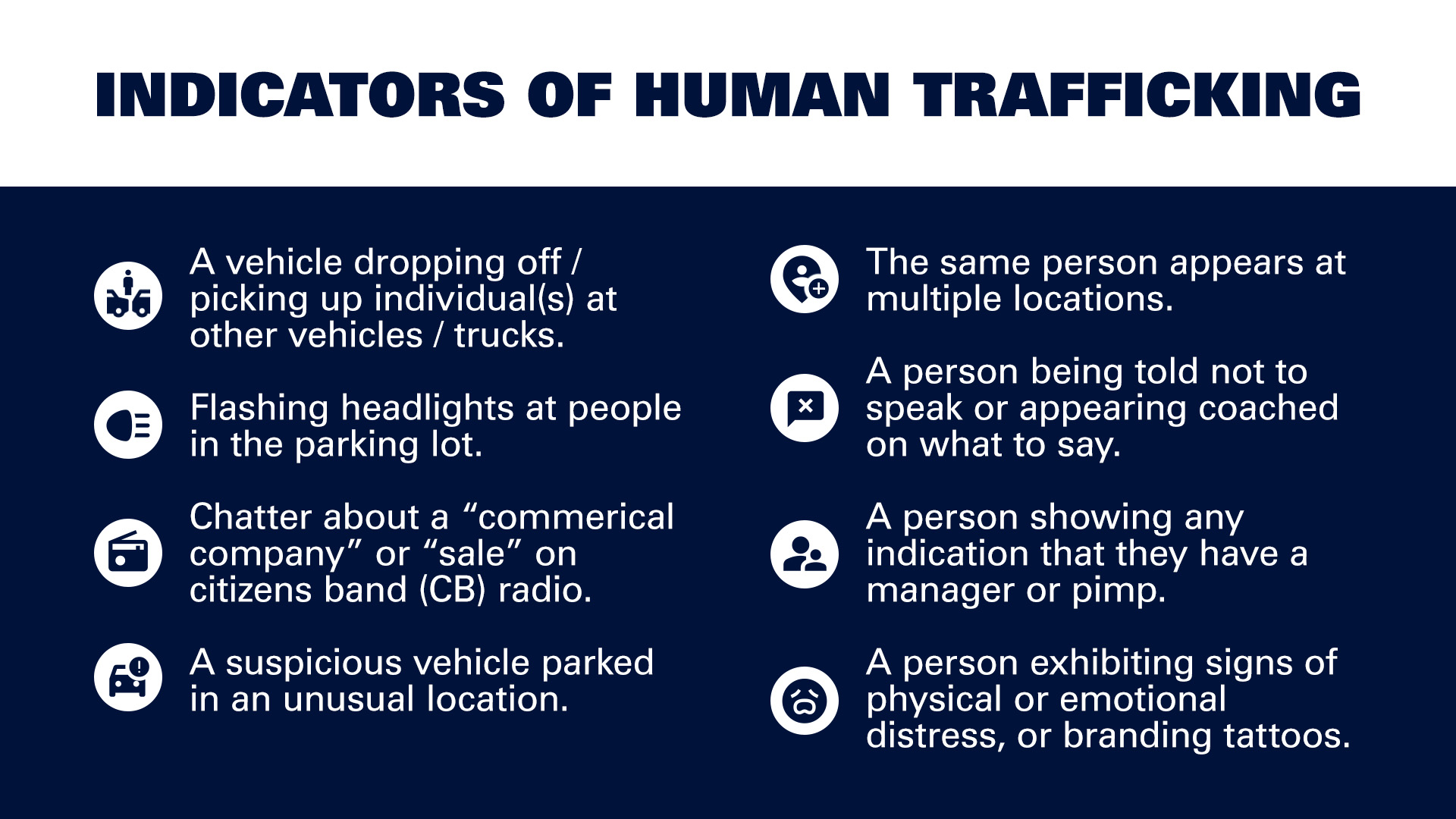
Traffickers often communicate on behalf of their victims or coach their victims on what to say to community members, employees, law enforcement, and other officials.
When in a situation where the trafficker purchases travel for a victim, victims will often arrive to obtain their ticket and lack knowledge or logical means to get to their final destination (e.g., no cash, use of prepaid credit cards/paid for before arrival, or not knowing the name of the person who booked their travel/who they are going to visit).
They might also be wearing clothing that is unsuitable for the season or inappropriate for their final destination.
One way traffickers advertise the need for customers at rest stops is through chatter on the CB radio that refers to “commercial company” or a "sale." Vehicles will then flash their lights to signal a “buyer’s” location. There are also many other common terms used in the CMV industry that reference commercial sex—you can learn more by reviewing Polaris’ Sex Trafficking at Truck Stops At-A-Glance document.
Trucks come and go from truck stops and rest areas at all hours. However, if you notice a passenger vehicle that pulls up and people get out of the vehicle and begin approaching trucks, you might be witnessing a trafficking situation. Similarly, the same can be said if a vehicle drops someone off at a truck and picks them up 15-20 minutes later.
Victims soliciting commercial sex might approach you and either (1) reference that they have a manager or pimp or (2) mention that they have to make a quota. These are often significant signs of a trafficking situation.
Some victims will often exhibit physical signs of distress when in a trafficking situation. They might have bruises in various stages of healing or may seem fearful, anxious, depressed, submissive, tense, nervous, paranoid, timid, uncomfortable around another person, and even disoriented or confused. Victims may also exhibit deprivation of food, water, sleep, medical care, and/or other life necessities.
Traffickers often threaten the victim and/or their family with harm, deportation, or law enforcement action if they attempt to leave, which often keeps victims from seeking help. While this indicator might not always be obvious, it is important to listen for this sign throughout your daily activities.
Human trafficking victims might not be able to freely leave a location, and access to transportation is a key obstacle for many victims trying to escape. Security cameras and locks are common wherever freight is delivered, but traffickers will often take unusual security measures to hide their activities. When traveling through cities and town, watch for barred or covered windows on houses, exterior cameras covering multiple areas, and buildings with alley entrances, especially if such measures seem out of place compared to the surroundings.
Traffickers often move victims to different locations in order to attract customers as well as avoid detection by law enforcement.
Last updated: Tuesday, May 26, 2026